LIRRA: Skip the Solve
Skip the Solve: Learning-Accelerated Recursively Feasible Interval-STL for Runtime Assurance
Evanns Morales-Cuadrado*, Xinpei Ni*, Luke Baird, Glen Chou, and Samuel Coogan. Submitted to the 2027 Learning for Dynamics and Control Conference (L4DC). *Equal contribution.
Showreel
All eight 3D experiments from the paper (6 min): the Skydio X2 quadrotor and the Georgia Tech Miniature Autonomous Blimp (GT-MAB) patrolling around the restricted cube under four specifications, with and without uncertainty in the cube’s boundaries, each introduced by a title card. The banner shows whether the latest learned proposal passed the STL check and, if not, which condition it failed while a verified plan flies in the meantime. Left: a 3D view of the cube, the waypoints and the plan in force (blue: accepted proposal, yellow: fallback solver plan, grey: cached plan). Right: the MuJoCo view, the robustness of the realized trace, and the robustness of each proposal against the acceptance threshold. Individual clips are on the project website.
From the paper
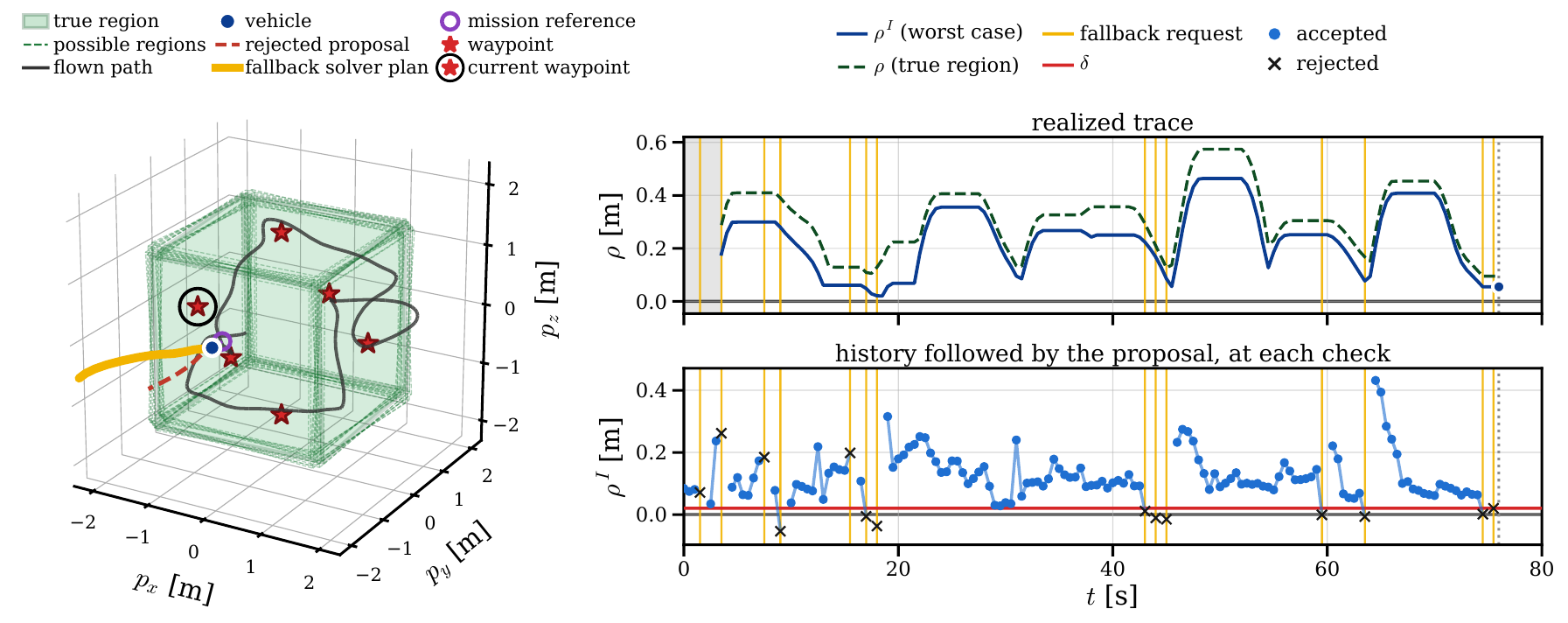
The problem. Autonomous robots must satisfy complex temporal specifications (deadlines, restricted regions, recurring obligations) while carrying out a nominal mission, and they must do so despite uncertainty in both their dynamics and the specification’s predicates, such as where a restricted region’s boundaries really lie. Runtime assurance is a natural fit: a nominal controller pursues the mission, and an assurance layer intervenes only as needed to keep the specification satisfied. In a receding-horizon loop, satisfying the specification over the current horizon is not enough; every plan must also leave a feasible continuation for future planning steps (recursive feasibility).
My interval STL runtime assurance work handles the uncertainty with interval signal temporal logic and guarantees recursive feasibility with control-invariant terminal constraints. The catch is that it solves a mixed-integer program at every planning step, which is expensive on small robots.
LIRRA (Learning-augmented Interval-STL for Recursively-feasible Runtime Assurance) skips most of those solves. A learned policy proposes a trajectory, and LIRRA checks the proposal against the original synthesis constraints, including the control-invariant terminal conditions. Checking a candidate is far cheaper than finding one. If the proposal fails the check, LIRRA starts a delay-compensated fallback solve and keeps following the last verified trajectory, which already carries a specification-satisfying continuation even if the solver fails or runs late.
Key ideas:
- Verify learned trajectory proposals against the exact I-STL synthesis constraints instead of trusting the network
- Fall back to delay-compensated MILP synthesis only when a proposal is rejected
- Always hold a verified, specification-satisfying continuation, so guarantees hold whatever the learned policy does and however long the solver takes
- Recursive feasibility and specification satisfaction under bounded dynamics and predicate uncertainty
Results (MuJoCo Menagerie Skydio X2 quadrotor and a custom MuJoCo model of the GT-MAB blimp, compared with standard MILP-based runtime assurance):
| Skydio X2 | GT-MAB blimp | |
|---|---|---|
| Planning steps needing a fallback solve | 0.6–1.3% | 4.1–7.7% |
| Mean computation per planning step | 50–83x faster | 5.3–7.4x faster |
| CPU energy per planning step | 39–135x less | 8.0–13.9x less |
On the X2, the standard method missed seven solver deadlines; LIRRA missed none.
Academic foundation:
| Venue | Status |
|---|---|
| 2027 Learning for Dynamics and Control Conference (L4DC) | Submitted |
Built around: Runtime assurance · Signal temporal logic · Recursive feasibility · Amortized optimization · Learning-based control